
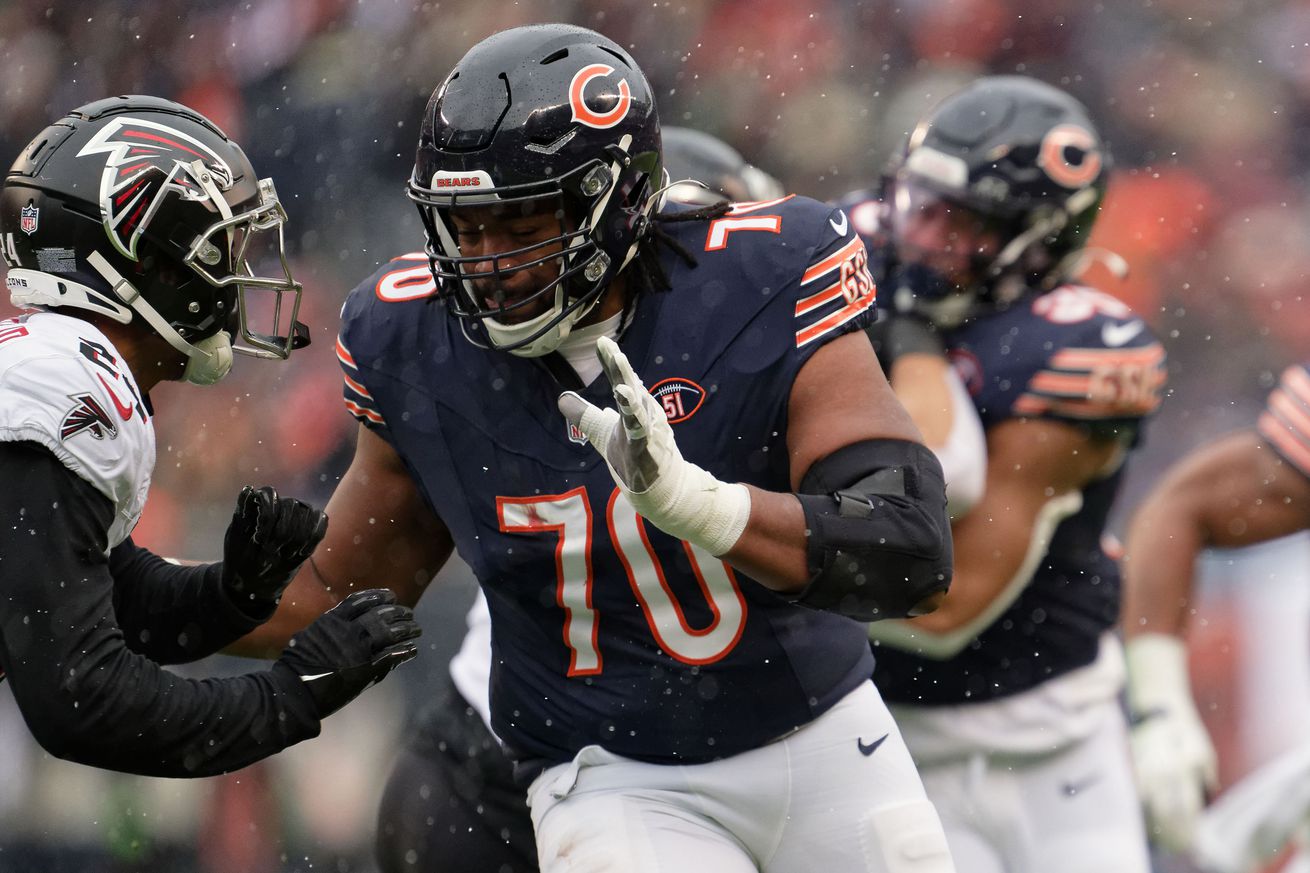
Training Camp 2025 is officially under way! With the regular season under two months away, the Chicago Bears have plenty to figure out before their Monday night opener. We’ll take a look at five questions that need to be answered heading into camp.
The 2025 edition of Chicago Bears training camp is finally here, and optimism is in the air as the team will take the practice field to open up the preseason preparations this week. Following a disappointing (5-12) season that saw multiple in-season firings, the time to win is now. First-year head coach Ben Johnson knew what he was signing up for when he took the job, which starts with playing in one of the best divisions in football.
Despite winning just 15 games over their last three seasons, expectations are high. Even if jobs aren’t directly on the line in 2025, there’s a sense of urgency around the building to make up for last time after a season was wasted in 2024. With a vastly improved roster, there won’t be nearly as many open jobs as in previous seasons. Even so, there are still plenty of questions to be answered before Week 1, and we’ll do our best to set the table heading into a highly anticipated season. Here are five questions surrounding the Bears heading into training camp.
1. Who wins the starting left tackle job?
Three-year starter Braxton Jones is coming off a serious leg injury and has yet to see time on the field during the offseason. To make matters even more complicated, he’s going into a contract year in a market that just paid Dan Moore four years, $82 million with $50 million guaranteed. Considering how much the Bears have invested in the interior of their offensive line already, it’s fair to assume that Jones is going to be out of their price range next offseason.
Luckily for Chicago, they have a pair of Day 2 selections that have received the benefit of first-team snaps through OTAs and mandatory minicamp. With Jones’ health still up in the air, one of Ozzy Trapilo or Kiran Amegadjie will get the first crack at the starting left tackle job for Week 1.
Fans shouldn’t convince themselves that either player would immediately come in and play at the same level as Jones. Then again, this competition is about more than just 2025. This isn’t to say that Jones couldn’t “win” his job back once he returns to full health, but my hunch is that they’d like to see one of Trapilo or Amegadjie grab the job and run with it.
It will be interesting to monitor how this coaching staff splits reps, especially once Jones returns and is healthy. It’s been a while since the Bears have had this much depth at tackle, but they still need someone to deliver.
2. How fast will the offense click under Ben Johnson?
The growing pains of a new offense are well-documented. Add in a second-year quarterback and (potentially) four new starting offensive linemen, and it’s a virtual guarantee that things won’t look pretty during the early portions of OTAs and minicamp. Due to the latest Collective Bargaining Agreement (CBA), teams have fewer opportunities to hit the field with a new coaching staff. This can lead to slow starts, and that has been the case (at times) for the Bears’ offense in the early going. With a six-week break between the introduction to this scheme and the installation of plays, we’ll get our first opportunity to see how much progress has been made.
When Johnson was hired, he discussed the expected mistakes that would occur early in the process. Not only did he say he expected them, he said he welcomed them. In a complex offense like Johnson’s, failure is a part of the learning process. Not only are they teaching a new offense, they are tearing down Caleb Williams to the studs and rebuilding them. Close to half of the offense will have new key contributors (and starters), which can help explain away some of the inconsistencies reported during the offseason program.
Despite the amount of newness involved in the offense, hitting the ground running once Week 1 opens will be a big key to any playoff aspirations they have. On paper, this is one of the best coaching staffs that Chicago has seen in close to two decades. It might not be something fans are accustomed to, but trusting this coaching staff to prepare a young offense for showtime is something we’ll all have to do. That starts in training camp with sustainable growth every week.
Lon Horwedel-Imagn Images
3. How serious are the Bears about adding a veteran running back, defensive end, and safety?
The Bears have been one of the “leaders” in available cap space over the last three offseasons, but until this offseason, general manager Ryan Poles has played his approach conservatively. This year, they spent a lot of money in both the cap and cash departments. Due to the way they structured their larger contracts, their cap flexibility heading into 2026 is as tight as it has been since the Ryan Pace era. Typically, that’s what happens when teams start winning, so as long as the wins come in 2025, there’s little to stress about.
That said, don’t be surprised to see Poles exercise a basic restructuring to someone like D.J. Moore, which would clear close to an additional $16 million for this year. The drawback to that is that it would incur a little less than $4 million in dead cap for each of the final years of Moore’s deal. The trade-off is simple: It gives the team an extra chunk of space to work with this year and also roll into next year. Even an additional $8 million in space this year could make a big difference, while also giving some extra flexibility next year.
According to Over The Cap, Chicago currently has just under $12 million in cap space after closing out their draft class. That would leave them with roughly $3-3.5 million in “usable” flexibility after accounting for the practice squad and typical in-season costs. They could clear more with a few minor roster decisions, such as cutting Chris Williams and his non-guaranteed $3.263 million cap hit, for example. Converting Moore’s base salary into a signing bonus and splitting the savings between the next two years would give the Bears closer to $10-11 million in “usable” space, without much punishment in 2026.
What could a theoretical $10 million buy the Bears before Week 1? Let’s take a look at a few positions (with projections):
Running Back
- Kenneth Walker III (Projected Trade: A 2026 fifth-round pick. Would take on $1.856 million in salary)
- Jamaal Williams (Projected Deal: One year, $1.255 million, with minimal to no guarantee)
- Audric Estime (Projected Trade: A 2026 sixth-round pick. Would take on $960,000 in salary for 2025)
Of the four positions on this list, running back seems the most likely to be addressed. The free agent options are far from plentiful, which could open the door for the Bears to explore the trade market. At most, they should be looking to give up a Day 3 pick, which is why Walker could make the most sense. Seattle has a crowded backfield and has shown no interest in extending Walker beyond his rookie contract. He’d cost less than $1 million against the cap, and could be had for a mid-day third pick. Williams has ties to Johnson going back to his time in Detroit. Could the Bears’ new head coach look to recreate his 2022 backfield? Finally, there’s Estime, who appears to be the odd-man-out in the Denver Broncos running back room. Despite being drafted just one year ago, the Bears might be able to flip a sixth or seventh rounder for Estime to get more of a chance in Chicago.
Edge Rusher
- Za’Darius Smith (one year, $8 million)
- Matthew Judon (one year, $4 million)
- Jadeveon Clowney (one year, $6 million)
- D.J. Wonnum (Projected Trade: A 2026 sixth-round pick. Would take on $7.05 million in salary)
For my money, edge rusher is the most pressing need on either side of the ball. We’ve seen plenty of the top offensive minds make it work with less at the running back position, but it’s hard to say the same with the team’s lack of depth off the edge. Sweat and Odeyingbo will be the team’s starters, but behind them, there’s no proven depth, which is a severe liability if they have playoff aspirations. The balance with paying another edge rusher is staying within a specific budget. Chicago doesn’t need to spend big money here, especially with the number of quality names left on the market. Smith makes the most sense, but will probably be the most expensive. The Bears had a serious interest in both Judon and Wonnum last year. Despite a new defensive coaching staff, I wonder if they could bark up that tree again over the next few months. Clowney is another fun name that isn’t a pure pass rusher but still brings plenty of size and well-rounded ability to any defense.
Safety
- Julian Blackmon (one year, $4 million)
- Marcus Williams (one year, $3 million)
- Vonn Bell (one year, $2.5 million)
- Marcus Maye (one year, $1.5 million)
Without injuries, a strong argument can be made for the team’s current depth chart being “good enough”. Not having a safety under contract for the 2026 season is the bigger issue. If they are currently looking to acquire some additional proven depth, Bell or May could make sense as players over the age of 30. Assuming they are looking to add someone with multi-year upside, Blackmon and Williams would make more sense. Williams is coming off a down year in Baltimore, but played his best football under Allen in New Orleans. Blackmon has been overlooked the last two offseasons, despite producing at an above-average level with the Colts. There are plenty of long-term questions at the position, but no one should be convinced that there’s a legitimate option remaining on the market that would answer one of those questions.
Linebacker
- Ja’Whaun Bentley (one year, $3 million)
- Kyzir White (one year, $2.6 million)
- Eric Kendricks (one year, $2.5 million)
Most fans are used to the SAM playing a notable role in this defense, but under Allen, that’s unlikely to be the case. Even so, there’s not much proven depth behind the two primary starters, which is why another addition could make sense. Bentley and White are the best remaining options, but it’s unlikely that they would settle for backup roles until later in training camp. Kendricks is long in the tooth, but had an impressive 2024 campaign, despite his age. My hunch is that the coaching staff will afford Noah Sewell and Ruben Hyppolite every opportunity to prove themselves as capable starters. If that doesn’t work, maybe they’ll dip into the veteran market for a mid-to-late August addition.
4. Which rookies in their eight-player class will stand out and earn roles heading into Week 1?
Part of fielding a successful team at the NFL level is drafting at a high level. One of the few benefits of having a bad team over an extended period is the ability to pick high in the draft. As fans from many different teams have learned, however, that doesn’t guarantee a successful drafting strategy.
The Bears’ hope is simple. If all goes well, this will be the last time they pick in the Top 10 for a long time. Now that the trade with the Carolina Panthers is officially completed, Poles will need to find a way to maximize his value without the extra picks that he acquired. The good news for fans is that this is something they’ll learn to adjust to next offseason. For 2025, the team boasts early-round talent. Of the team’s eight draft picks, four of them came within the first 62 picks. In theory, all four of those players should end the season earning significant roles. In reality, we should know that not every pick in the opening rounds will hit. Even if they do, it could take a year or two for them to become impact players.
Tight end Colston Loveland, receiver Luther Burden III, and offensive tackle Ozzy Trapilo have the best chance of cracking the team’s starting lineup once Week 1 rolls around. Loveland will split time with Kmet early on, but the two players have different skill sets and ultimately should play various roles. With DJ Moore and Rome Odunze ahead of Burden in the pecking order, there’s a strong chance that the second-rounder sees most of his snaps out of the slot and in schemed-up situations to get him the ball. Trapilo has a real opportunity to win the starting left tackle job out of camp, but much of that will depend on the health of Braxton Jones, who is still recovering from his broken leg suffered late last season.
Defensive tackle Shemar Stewart and linebacker Ruben Hyppolite should see rotational snaps, with Hyppolite having a real opportunity to win the starting SAM role. The issue is that Dennis Allen doesn’t use a third linebacker very often, which would limit his impact in Year 1, barring injury. Cornerback Zah Frazier is another interesting name, but it’s worth remembering that he was a one-year starter at UTSA. He performed well against Green Bay Packers first-round pick Matthew Golden, but most of his ball production last season came in three games. Despite his age, Frazier is more of a developmental prospect who could cut his teeth in dime packages.
Running back Kyle Monangai doesn’t have an impressive physical profile, but his bruising running style and ability to pick up extra yards could have him in line to compete with Roschon Johnson for RB2 snaps. The former Rutgers product’s ability to be a threat out of the backfield as a pass catcher might dictate his role early on. Finally, sixth-round pick Luke Newman is on the roster bubble heading into camp. It’s clear that Poles likes him, but there wasn’t a whole lot on tape that screams “roster lock”. That’s not to say that he can’t be the ninth or tenth offensive lineman on the roster this year, but he faces the steepest climb for a roster spot.
In a best-case scenario, the Bears’ top three picks will be starters by the end of the season, with players like Turner, Frazier, and Monangai playing valuable roles. More realistically, four of their eight-man draft class will see real playing time in Year 1. Fans just have to hope that it’s meaningful production and the learning curve isn’t too big.
5. How will the defensive tackle rotation shake out?
For the first time since the golden days of the Vic Fangio era, the Bears have depth on the interior of their defensive line. Despite former head coach Matt Eberflus saying he was making it a priority, he never produced top-end talent at the position. Once the new coaching staff was hired, they truly made this spot a priority, and it shows on the depth chart. Gervon Dexter Sr. and Andrew Billings are returning, along with the retention of free agents like Chris Williams and Jonathan Ford. The signing of veteran Grady Jarrett surprised most on Day 1 of free agency, and they followed it up by selecting Turner with one of the final picks of Round 2. Oh, and we probably shouldn’t forget about former third-round pick Zacch Pickens, even if he’s a long shot to make the final 53-man roster.
One could argue that the Bears are six, maybe seven deep at defensive tackle, and it’s unlikely that all seven make the team. If I were a betting man (I’m not), I would assume that Pickens and Williams would be the odd men out, assuming the team keeps five on the roster. Pickens has not only failed to impress as a Day 2 pick, but his 2024 campaign was somehow more troubling than his rookie season. Some of that could be attributed to his role as a nose tackle, but the fact that Williams and Ford out-snapped him by the end of last season is not a good sign for his future in Chicago. Williams’s $3.263 million cap hit is fully non-guaranteed, and it’s hard to imagine many scenarios where they choose to pay their DT5 that much money. Considering his struggles against the run, the former Brown feels like a long shot to make the final roster.
Regardless of who the fifth defensive tackle is, the team must figure out its rotation. After handing Jarrett $14.5 million per year, it feels like a virtual lock that he’ll be starting at one of the two spots. That leaves three players battling for one starting spot. Dexter makes the most sense to me, but how much will their run game suffer without Billings anchoring the middle? I have high hopes for Turner’s career, but barring a breakout camp performance, he feels like a player who is going to be expected to star in a situational pass-rushing role early in his rookie season.
If I had to guess right now, Jarrett’s ability to play the run well enough should allow them to start Dexter at 3T. This leaves Billings to rotate on obvious running downs, and Turner to provide extra juice as a pass rusher on third downs. It might take them a month or two to figure out the best groupings, but fans should be excited about the prospects of this group. If all goes well, they’ll have enough upside to consistently “dent” the pocket and enough depth to maintain a high level of play throughout the season.