
When Luke Saunders came up with the novel idea to sell salads from a vending machine 12 years ago, it was so far out of the box that he had to invent a new one.
Believing that fast food should be faster and healthier, Saunders dreamed up the concept of Farmer’s Fridge without a blueprint on how to do it. For starters, vending machines, which had long dispensed chips, candy bars and sodas to snacking office workers, simply weren’t set up to deliver fresh salads on demand.
So Saunders, then a recent college graduate and novice entrepreneur, created a prototype, stuffed it with fresh greens, stuck it in a downtown Chicago food court and launched the salad vending company in October 2013.
“When I started back then, I probably didn’t sleep for a month because I had spent my life savings on a vending machine, and I had to figure out by launching it if people were going to sign up to buy an $8 salad out of a machine,” said Saunders, 39.
As it turned out, they did.
A dozen years later, Farmer’s Fridge has a 100,000-square-foot kitchen near Midway Airport and thousands of locations across 20 states selling salads to millions of customers. Growth has exploded this year in what has been a very challenging environment for many restaurant chains, as Farmer’s Fridge and its vending machine salads go mainstream.
The stand-alone salad machines, which have sprouted up in office buildings, warehouses, airports, hospitals and on college campuses, have carved out a new niche in the fast-food and vending industries, with plenty of room for upside, according to at least one analyst.
“I think the economies of scale tend to fit very nicely for Farmer’s Fridge, and I think they’ve got tremendous growth opportunities until somebody else comes into the market and replicates it,” said Darren Tristano, CEO of Foodservice Results, a Chicago-based research and consulting firm.
From McDonald’s to Portillo’s, Chicago has given rise to some of the most iconic fast-food chains in the U.S. Few have an origin story as unique as Farmer’s Fridge.
A New Jersey native, Saunders majored in international studies and Chinese at Washington University in St. Louis, but his career path evolved from a side hustle.
“I was running a bike rental business on campus,” Saunders said. “I was having way more fun doing that, so I decided I wanted to be an entrepreneur.”
After college, Saunders joined his father’s grease lubricant manufacturing business in New York. When his girlfriend and future wife got into University of Michigan Law School, Saunders went with her, leaving the family grease business behind.
In Michigan, Saunders got a job selling industrial metal finishing products, driving 1,000 miles a week across the Midwest to pitch engineers and factory managers on how to use coatings to improve their operations.
As a traveling salesman, trying to improve his own diet was another story.
“Driving all over Michigan, Ohio, Indiana, Kentucky, the only options for me were fast food or a gas station,” Saunders said. “When I really wanted some healthier food, I would find a Chinese restaurant and get some steamed vegetables and chicken. This is really way too much work.”
While fast-casual salad chains like Sweetgreen already existed on the East Coast, Saunders began to ponder new ways to peddle lettuce across the heartland.
The light bulb went on during a visit to an Ann Arbor health club, when staff opened a small fridge packed with fresh-made salads and sandwiches to sell to members. Saunders thought he could scale up the idea at other health clubs.
Unfortunately, nobody would bite, forcing Saunders to find a different distribution network. That’s when he decided on vending machines to dispense salads.
The big problem — they didn’t exist.
“I actually tried to build a machine from scratch. I thought I had to invent this thing,” Saunders said. “So I went to engineering firms in Chicago and said, ‘What would it cost to build a machine that sold salads?’ I got the quotes back, and it was like half a million dollars to get a prototype.”
Instead, at the suggestion of his father-in-law, Saunders attended the April 2013 National Automatic Merchandising Association convention in Las Vegas — an annual trade show for the vending machine industry — where he networked with manufacturers and kicked the tires on the latest models.
Not surprisingly, there was nothing there ready to spit out salads on demand, but Saunders saw a few offerings that he believed could be adapted to his unique vending application. Working with several manufacturers, he engineered a mashup, putting the finishing touches on the machine himself.
“I was literally cutting holes in the side of a vending machine, ripping out parts, changing how it worked,” he said.
The newly married couple moved to Chicago in June 2013 after his wife graduated from law school and got a job at a large law firm. Meanwhile, bootstrapped with $25,000 in savings — of which 85% went to building the first vending machine — Saunders geared up to launch his company.
The first Farmer’s Fridge opened at the Garvey Food Court at Clark and Lake streets, a downtown mélange of fast-food offerings such as Dunkin’ Donuts, Popeyes and McDonald’s that also featured a newfangled salad vending machine in the middle. The food court closed more than a decade ago, but Farmer’s Fridge has since grown exponentially.
In addition to coming up with the concept, Saunders initially created the actual salad mixes. But early market research found that while customers loved the convenience of fresh salads from a vending machine, the actual taste left something to be desired.
“That’s when I gave up my title as the recipe developer and hired a chef,” Saunders said.
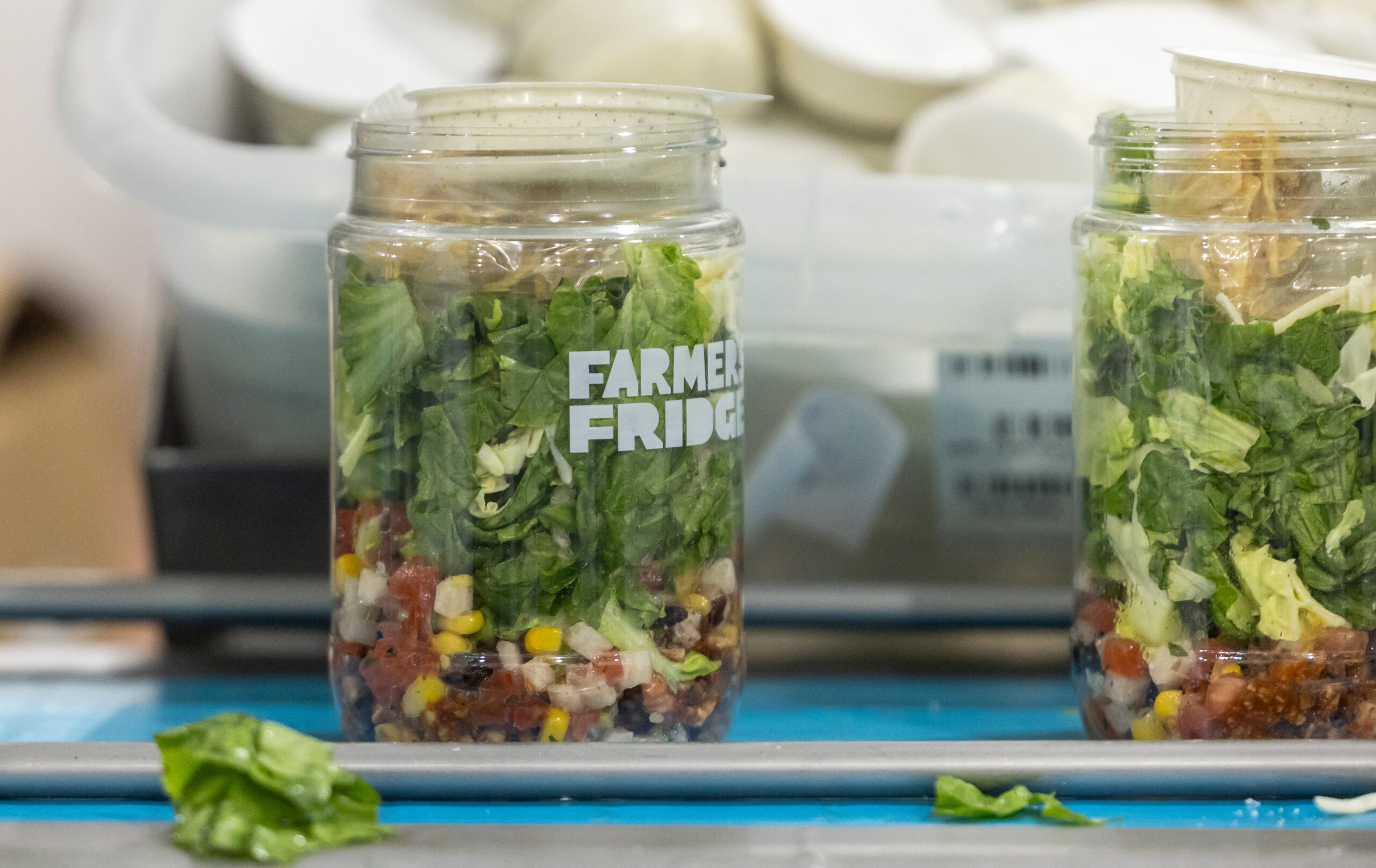
The on-the-go jars of fresh salads caught on quickly, with vending machines popping up at a variety of busy locations in Chicago and beyond. Farmer’s Fridge now works with a Spanish manufacturer to make custom salad vending machines, which cost about $10,000 each.
The company has raised $100 million to date, fueling annual revenue growth and broader expansion. Cleveland Avenue, the Chicago-based venture capital fund led by former McDonald’s CEO Don Thompson, is the largest investor in Farmer’s Fridge, Saunders said.
In 2019, Farmer’s Fridge moved its manufacturing operations from an 8,000-square-foot kitchen facility in the West Loop to a 50,000-square-foot facility on Cicero Avenue near Midway that formerly housed a meal-kit company.
Then the pandemic hit, turning downtowns into ghost towns and disrupting the core Farmer’s Fridge business model. The company expanded into retail and briefly, home delivery, moved into new locations and quickly resumed its upward trajectory.
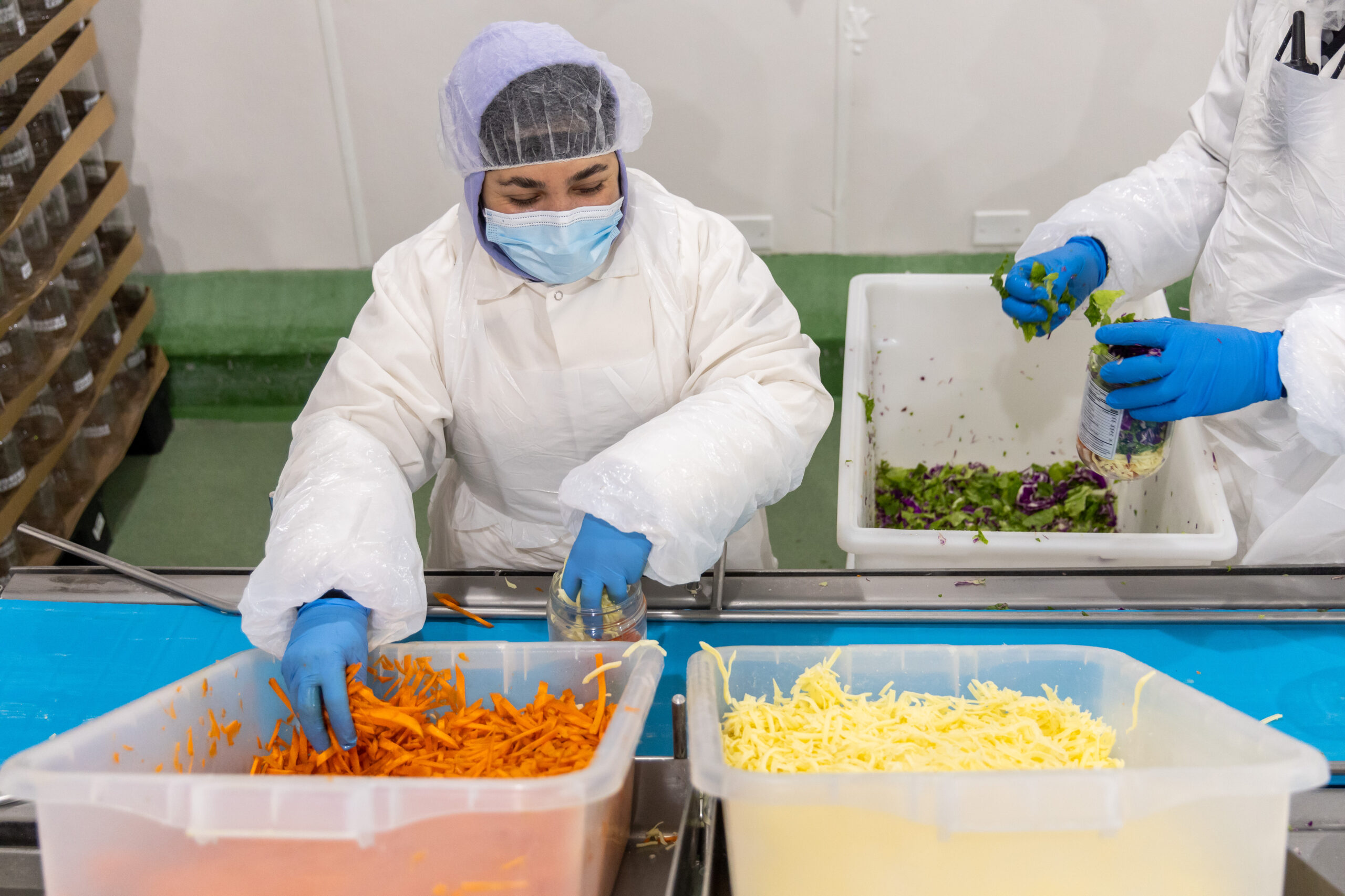
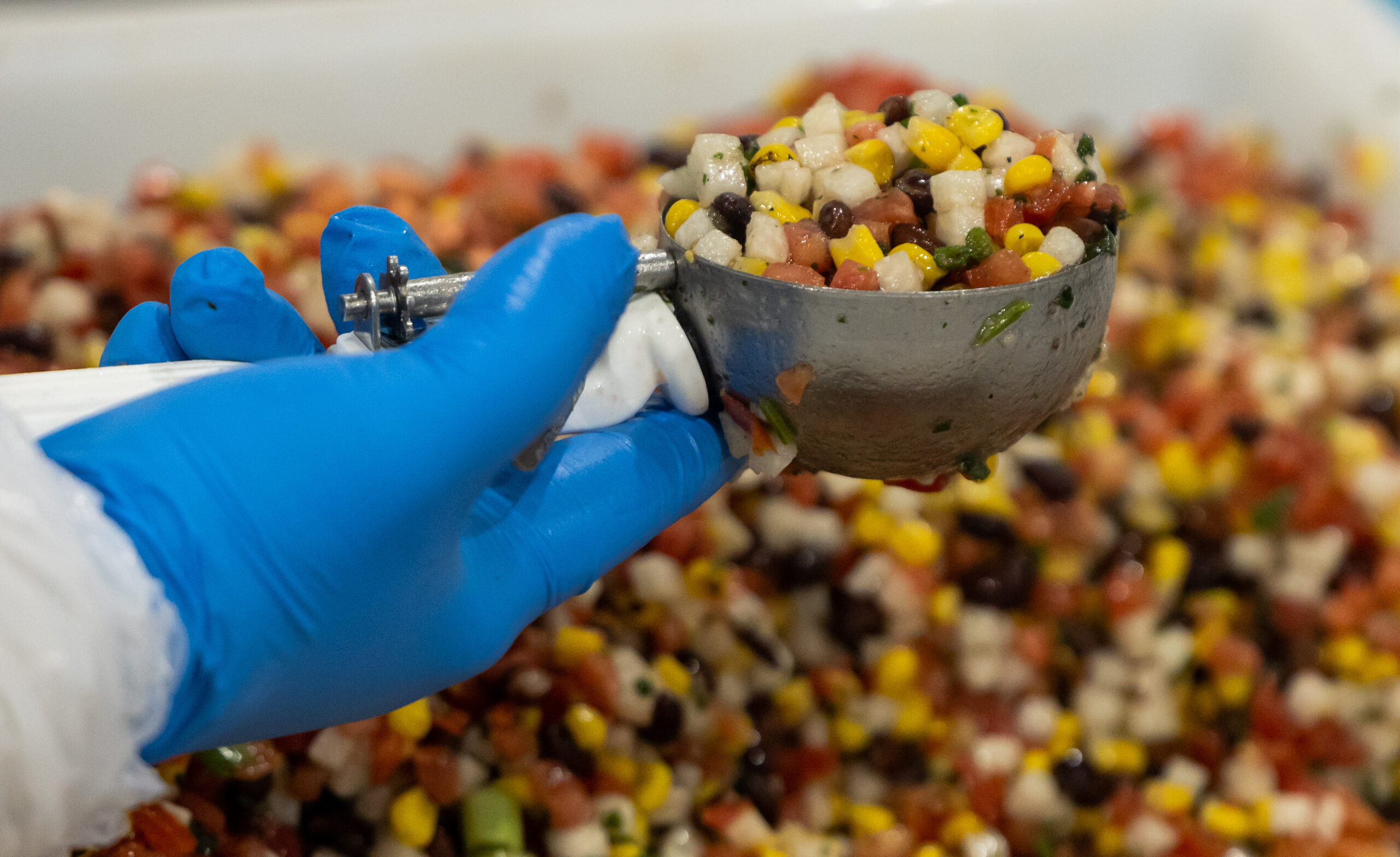
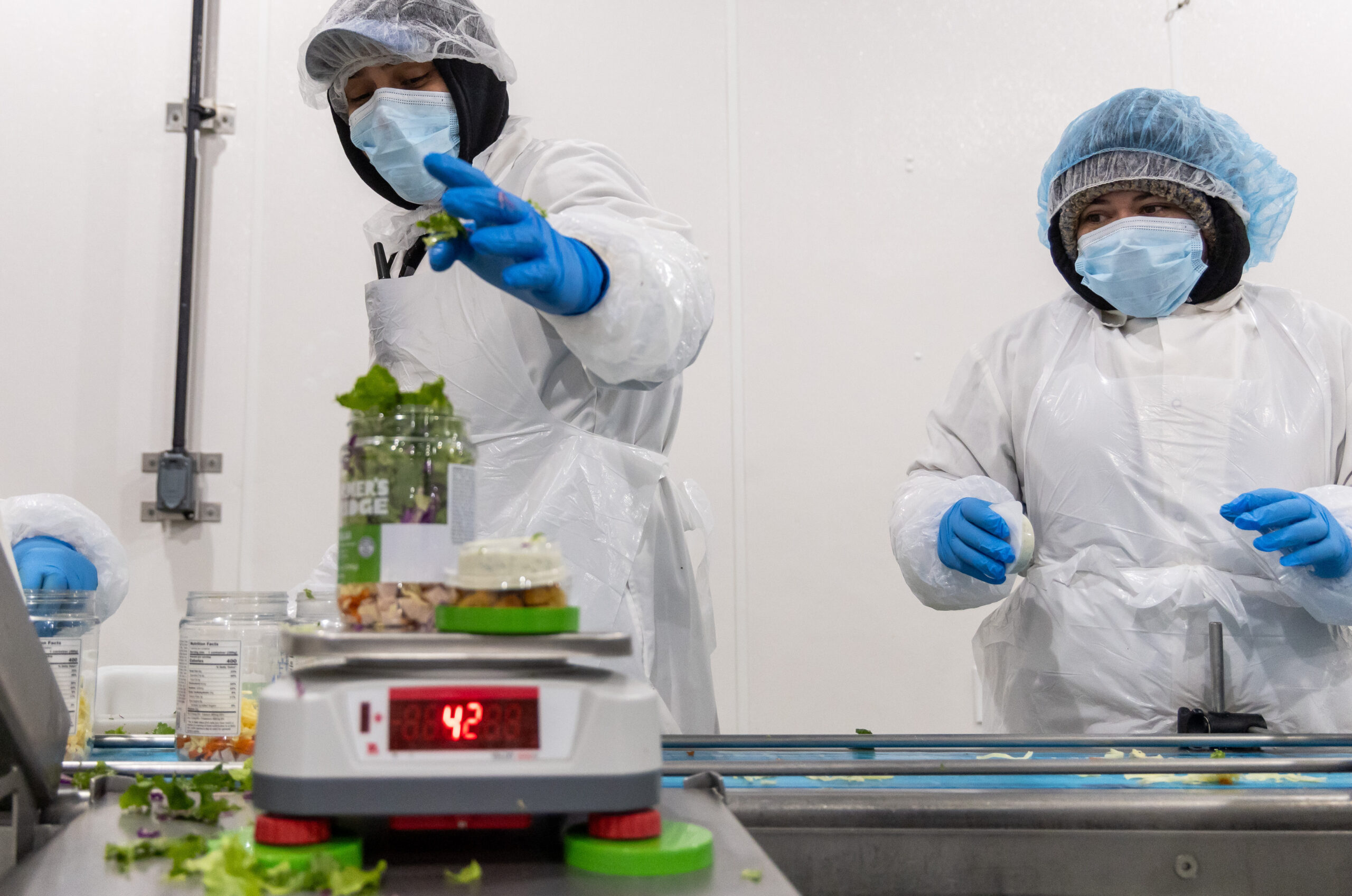
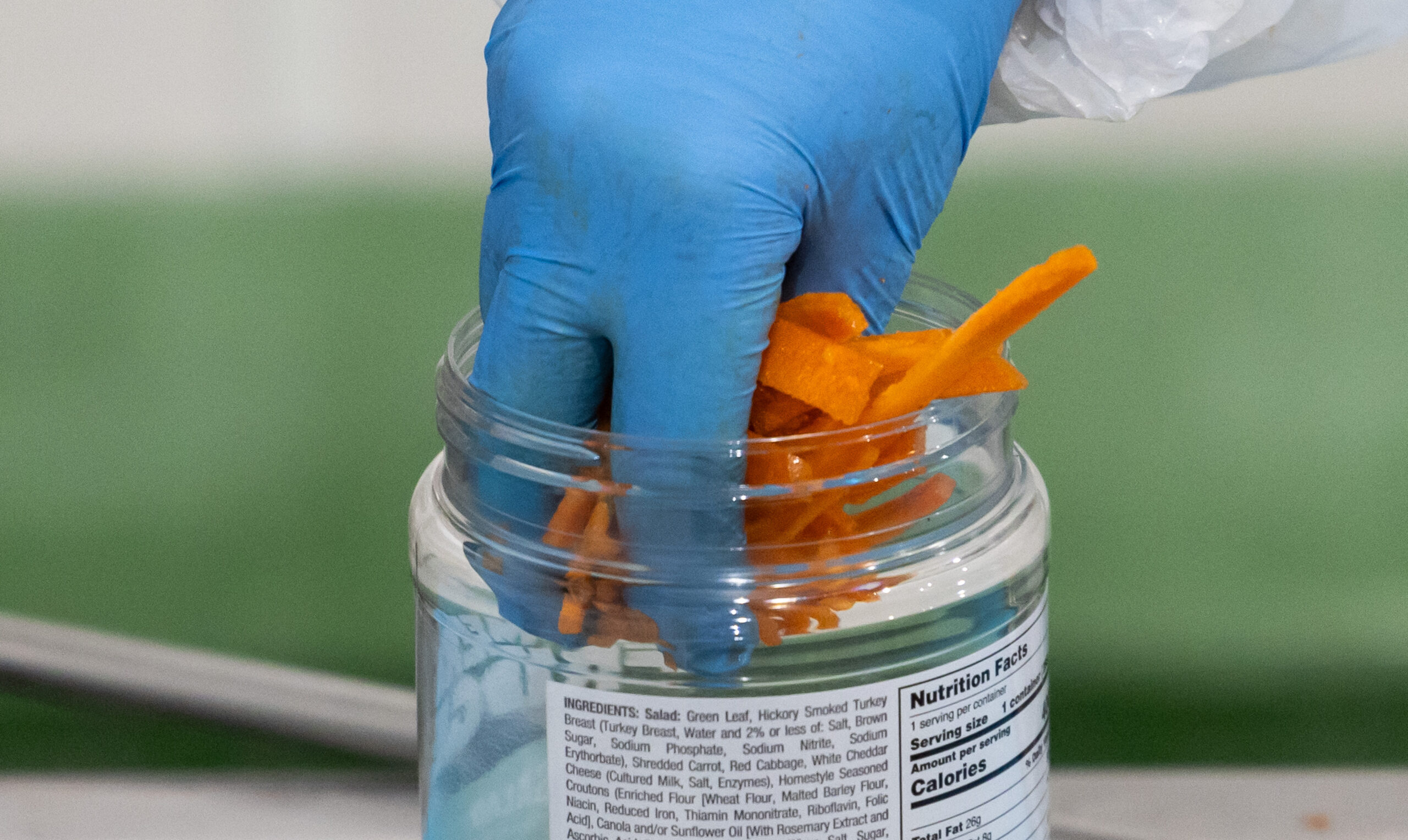
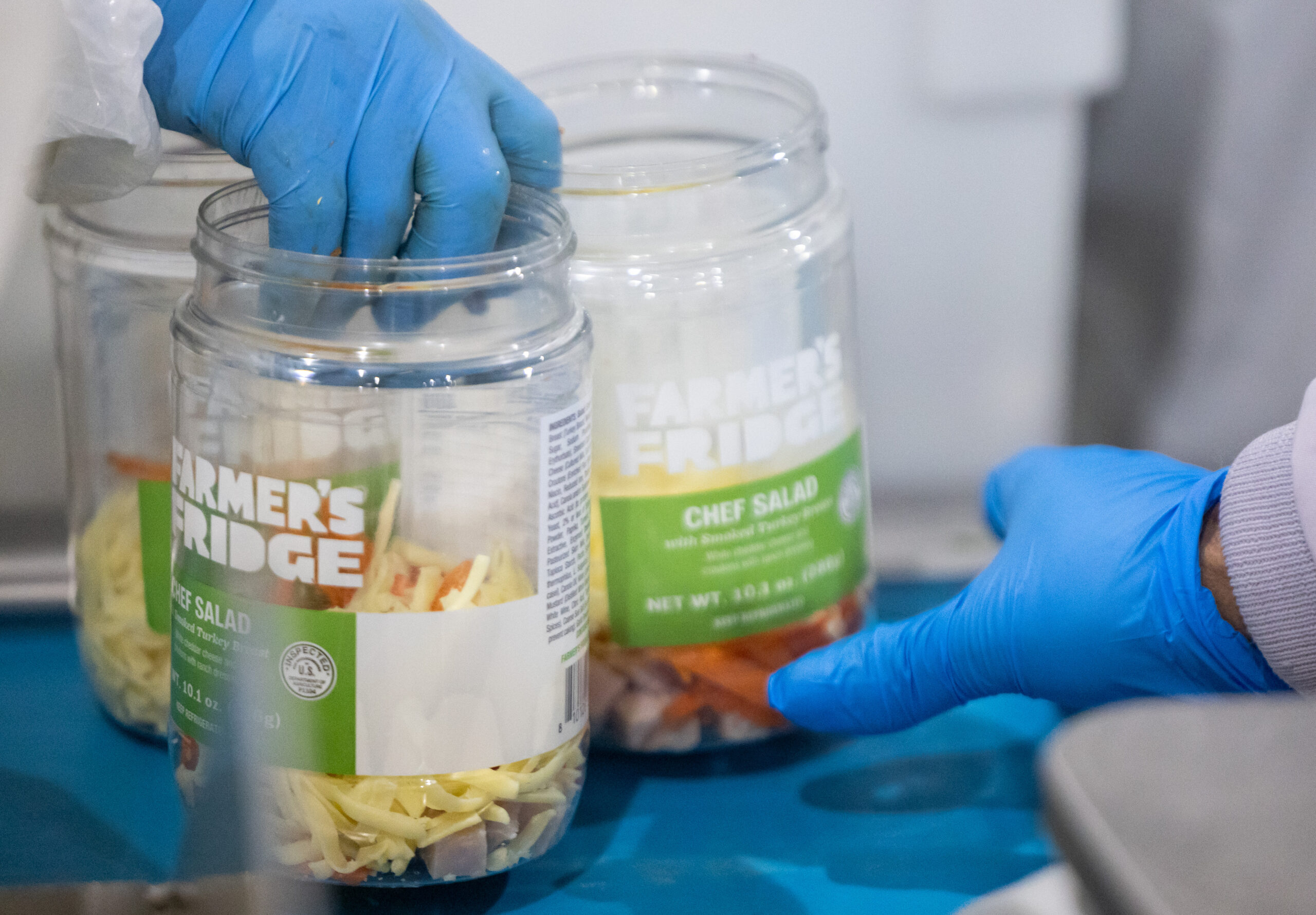
Farmer’s Fridge has since doubled its kitchen to 100,000 square feet as business expands nationally, and through retail channels, with 350 employees making the salads 24/7 on two shifts to meet growing demand.
There’s now 1,900 fridges and another 1,500 retail locations carrying the Farmer’s Fridge salads in 20 states, from Southern California to Texas to Massachusetts. All of the salads are prepared in Chicago and then trucked across the country.
The salads, which have a one-week shelf life, lose about one day in transit to the most far-flung destinations, where Farmer’s Fridge employees receive the deliveries and distribute them to vending machines in a well-coordinated race against wilting lettuce.
“When I started, that was our biggest challenge,” Saunders said. “Over time, we’ve really optimized the shelf life and the planning process.”
Popular items include the high protein Medi chicken bowl, Southwest salad with chicken, pesto pasta bowl and a new collab with California Pizza Kitchen featuring the restaurant chain’s signature BBQ Chicken Chopped Salad.
Farmer’s Fridge projects it will sell 10 million meals in 2025, a dramatic increase that represents a third of the company’s total sales volume over its entire 12-year existence. Saunders declined to disclose sales revenue, but said it has averaged 70% annual growth since inception.
With Chicago office buildings still at about 58% of pre-pandemic occupancy levels, according to the latest weekly report by Kastle Systems, Farmer’s Fridge has had to evolve and expand to grow at such a rapid pace in the post-pandemic landscape.
That includes picking up more space at airports and Amazon fulfillment centers, moving into new markets across the country and developing retail partnerships to sell its products on store shelves.
Farmer’s Fridge salad jars are now available at Aldi, Target, Walmart and Jewel, among other retailers.
Before the pandemic, 40% of revenue for Farmer’s Fridge came from office vending machines. That part of the business is now about 10% of the company’s revenue, but Farmer’s Fridge has since grown tenfold through diversification and geographic expansion, Saunders said.
“We have more locations in Amazon fulfillment centers than we do in airports,” Saunders said. “We’ve picked up volume just from having a business model that’s more aligned to the new way of working.”
The vending machine business still accounts for 80% of the overall revenue at Farmer’s Fridge, Saunders said.
While major fast-food chains like Portillo’s struggle with slowing sales and McDonald’s rolls out extra value meals to compete in a tough restaurant environment, Farmer’s Fridge continues to grow. Prices for the salads still average about $8 at most vending locations, with higher prices at the airports, Saunders said.
Farmer’s Fridge may be bucking the trends in part due to its location, location, location mantra, tapping into shifting centers of activity and customers more likely to pay up for a healthy meal — without waiting in line, Tristano said.
“For them to pivot, they walk in with a two-wheeler, they grab their vending machine and they move it somewhere else,” Tristano said. “When it comes down to it, the mobility they have with being able to move between office buildings, between retail locations, is really a huge advantage.”
And as more people return to the office over time, Farmer’s Fridge will be there as well, presenting a healthier alternative to the burger-on-the-run or the 3 p.m. candy bar from an old-school vending machine.
But in the new paradigm, that once-core office business may simply be the icing on the cake for Farmer’s Fridge.
“Those numbers keep getting better in terms of people downtown, so over time it should recover, but we took a lot of steps to diversify, and overall it made us a better business,” Saunders said.