
At most universities, learning a foreign language consists of tracing characters, memorizing vocabulary and comprehending texts. But professor Hana Kang’s Korean language course at Notre Dame can look quite different. On Nov. 20, students of all levels stepped into the world of virtual reality, entering a traditional Korean scholar’s lounge to experience their lessons on classical poetry and centuries of scholarly tradition come to life.
In class, first, second and third-year Korean students wrote their own personal poems in the Pyeong Sijo style, the most common and refined form of the broader tradition of classical Korean Sijo poetry.
According to Kang’s course materials, Sijo is “known for its musical origins, expressive tone, and compact elegance.” A Sijo poem traditionally consists of three lines, each of which can be divided into two parts to establish its distinctive rhythmic flow.
The artistry of Sijo is closely tied to the structure of the Korean writing system. InKorean, each letter of the alphabet represents a specific sound but is unable to stand alone; instead, letters are combined into ‘syllable blocks’ of two or more characters. As each Sijo poem is made up of 44 to 46 syllables, its form reflects the unique nature of the Korean language.
Freshman Owen Nichols described the intricacies of the language. “It’s very difficult at first, especially learning a new character system, like trying to make new sounds that aren’t in English. The grammar can also be a little bit of a challenge. But over time, it gets a little bit easier,” he said.
Alongside poetry, students also examined the culture of traditional Korean scholarship. Key concepts included seonbi, historic Korean scholars, and the sarangbang, a scholar’s private study.
Students learned thatseonbi embodied scholarship, integrity and moral leadership during the Joseon era (14th century to early 20th century) of Korea. A seonbi’s “lifelong pursuit of su-yang, or moral self-cultivation, was grounded in rigorous academic study,” and “as intellectual and moral leaders, [they] upheld and taught Confucian values, shaping the culture and ethical foundations of their communities,” Kang’s course materials said. For modern Korea, seonbi continue to symbolize disciplined thought, humility and a commitment to justice and social good.
The sarangbang was a space “dedicated to reading, writing, artistic practice and intellectual conversation. Its minimalist aesthetic of white walls, low furniture and intentional arrangement reflected the seonbi’s devotion to modesty, clarity and disciplined thinking,” according to the course materials. Using virtual reality, students were able to take on the perspective of seonbi themselves.
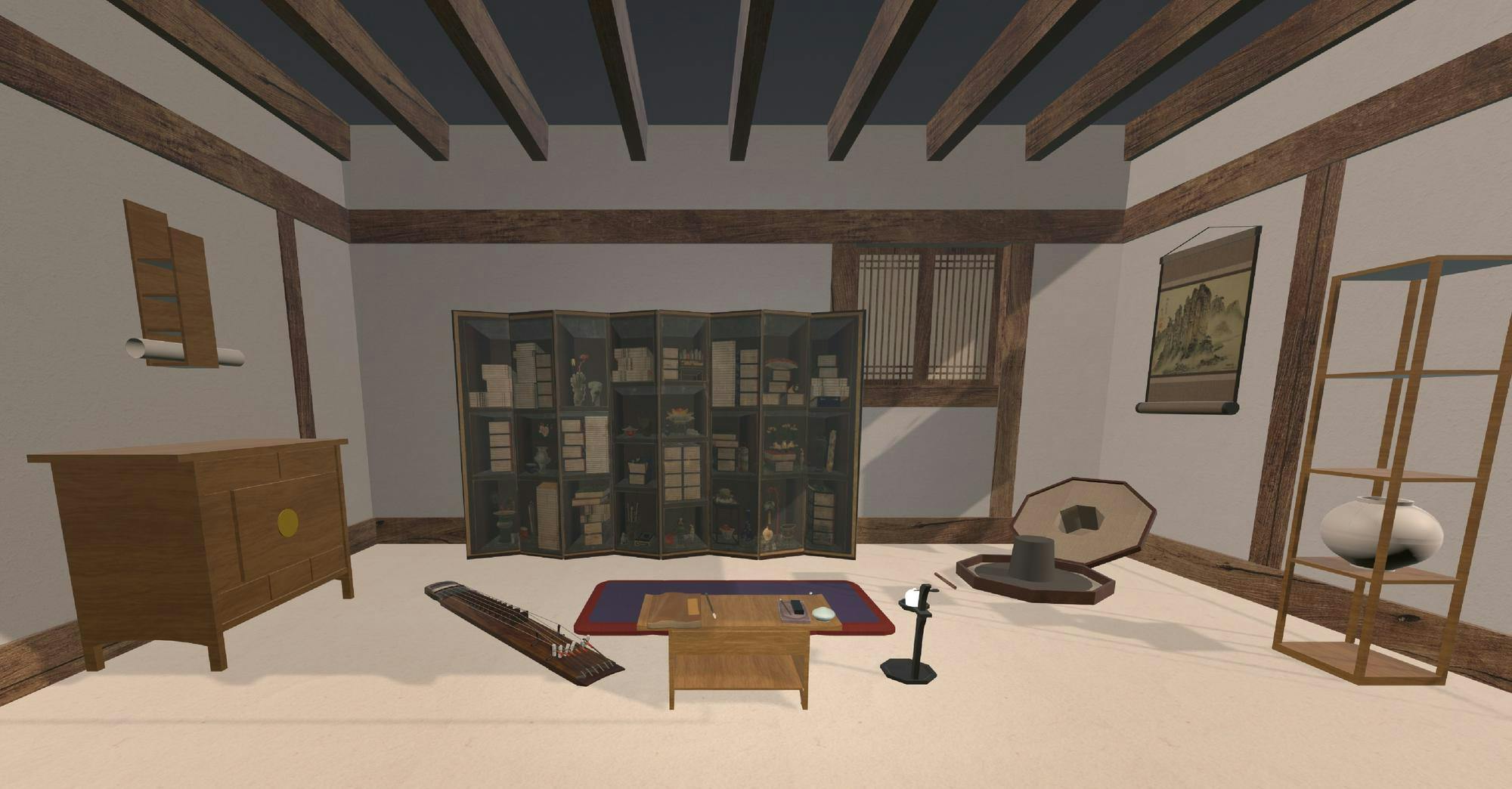
Surrounded by essential furnishings and artifacts, students got to explore what it was like to be in a sarangbang, experiencing firsthand the environment in which classical scholars wrote, studied and exchanged ideas. Elements within the space included a writing desk, shelf, porcelain jar, scholar’s hat and storage case and writing utensils. In addition, students were able to play a geomungo, a Korean zither instrument.
A notable feature of the virtual space was the placement of students’ poems throughout the room, each one discoverable by interacting with different artifacts. As they explored, students could uncover their peers’ work and listen to audio recordings of classmates reading their poems aloud.
Freshman Leonard Siegal emphasized the uniqueness of the experience. “I’m surprised that we got to do it for this class. Out of any class, I wouldn’t have thought it would be Korean. But I really appreciate that we got the chance to use it … there’s a lot of thought and intention behind it,”he said.
This virtual reality experience came about through a collaboration between Kang and Adam Heet, Hesburgh Library’s digital projects specialist. Having worked with Kang before, Heet said he wondered, “What else could we offer with our tools or technology to help faculty be successful, or to just make something more engaging for the students?”
Heet said he “realized that there was an opportunity to come up with a virtual environment of the spaces that [Kang] was teaching about.”
“Instead of just showing a graphic on paper or a picture in slides [of] what a scholar’s lounge looks like, let’s recreate it so [students] get a sense of what it’s like to actually be in the space emotionally, rather than just mentally.”
Heet explained that the room was designed through several iterations. “At one point you could be outside, inside, there was nighttime and some fog.” But ultimately, the collaborators wanted “to make sure that this space reflected the actual kind of solitary mental pursuits that should be happening in this space, and not just be fun and interactive.”
Kang said that their goal was “to make classical Korean culture tangible, interactive and accessible to all learners, regardless of Korean language proficiency.”
In addition to this virtual reality experience, Kang integrates technology into her course in many unconventional ways. Blending traditional Korean painting principles with modern tools, students recreated artwork for their poems by combining hand-drawn sketches, digital design software and generative AI. Each poem also featured a QR code that linked to an audio recording of the student reciting their poem in Korean.
In a previous class, students designed their own personalized dojang, or traditional Korean name seal. Using the Navari Family Center for Digital Scholarship’s 3D printers, these hand-drawn designs were turned into physical stamps that students used to sign their poems.
Freshman Emily Schmidt said that these activities enhance her classroom experience. “It definitely helps foster curiosity, seeing how the grammar, sentences and words interact with culture. It makes you think about it in a way you don’t really think about it with your native language,” she said.
Many students praised Kang’s efforts in teaching Korean, sharing that she often brings in Korean snacks and artifacts to class to supplement the course content.
Nichols said he likes that the class is “not just sitting there and just learning the language. [We] embrace the language in terms of culture, different food, different customs, different traditions and actually like learning about the whole [country], not just the language.”
Similarly, Siegal said that he enjoys the class “because it has so many different components to it. There’s a very large emphasis on the Korean tradition. This isn’t just a language class, which I really appreciate. It’s a Korean culture class in a lot of different ways, which has been very enjoyable.”
Freshman Anna Kim said she believes “it’s obvious how much [Kang] cares in trying to teach us the language, but also the culture … Last week we made kimchi together, which is super cool. I’m not doing that in any other class.”
Kang said her teaching approach stems from the knowledge that her students are “smart, they’re motivated and they know that they can even self-study.” However, she believes that “one thing they may lack is the community learning experience which they cannot have through study[ing] Korean by themselves.” Thus, she tries to showcase facets of the culture, such as art and beauty, that are hard to access or students may have a misconception of.
In addition to conventional avenues, Heet believes immersive experiences can provide students a richer understanding of what they learn in class.
“Students that take the time to walk around the space, and [create] their own interactions in trying to find things that work [within] the space, so what they take away from it is a much more unique interaction with the content,” he said.
“Our position in the Navari Family Center for Digital Scholarship is that we want people to come in and bring an idea with them … come in and ask, and we’ll talk about it with you, and we’ll see if it’s viable,” Heet said. “My job here, ultimately, is to keep our doors open to people who want to understand or participate in the VR ecosystem. That might be making something that’s incredibly academic, or they just heard that they could swing lasers around in VR, and they want to try for fun. Our door is open to all of those types of requests.”